

Why Side Projects Never Leave Practice Mode
How consequence, not motivation, turns builders into performers


Most conversations about side projects assume the problem is execution.
Not enough consistency.
Not enough motivation.
Not enough discipline.
That assumption mirrors an old mistake in sports training.
When an athlete plateaus, the instinct is to train harder. More drills. More reps. More volume. But coaches know the real issue is rarely effort. It is almost always the environment.
Training without competition produces movement, not adaptation.
Side projects suffer from the same flaw.
The real reason most side projects go nowhere is not that people fail to execute. It is that they are never placed in conditions where execution is required.
They are structurally designed to be ignorable.
And humans, like athletes, do not adapt to what feels optional.
Daniel Kahneman, a Nobel Prize–winning psychologist whose work shaped modern understanding of decision-making and attention, once observed:
“Nothing in life is as important as you think it is while you are thinking about it.”
Without stakes, side projects never reach the threshold where the mind considers them important, requiring action.
The Thesis: Consequence Is the Missing Variable
Side projects fail not because they are hard, but because they are consequence-free.
More precisely, they fail because they impose no real consequences on the builder himself.
No penalty for delay.
No cost for quitting.
No identity loss for walking away.
In athletics, training sessions without races, matches, or measurable outcomes quickly lose their edge. A runner who never races learns how to run comfortably, not competitively. A lifter who never tests a max learns how to move weight, not confront limits.
Side projects function the same way. Without consequence, they remain practices that never graduate into performance.
Seth Godin, entrepreneur and long-time observer of creative work and commitment, has argued that people do not need more time so much as they need to decide. Decisions harden only when something is at stake. Side projects rarely force decisions because nothing meaningful happens if the builder refuses to make one.
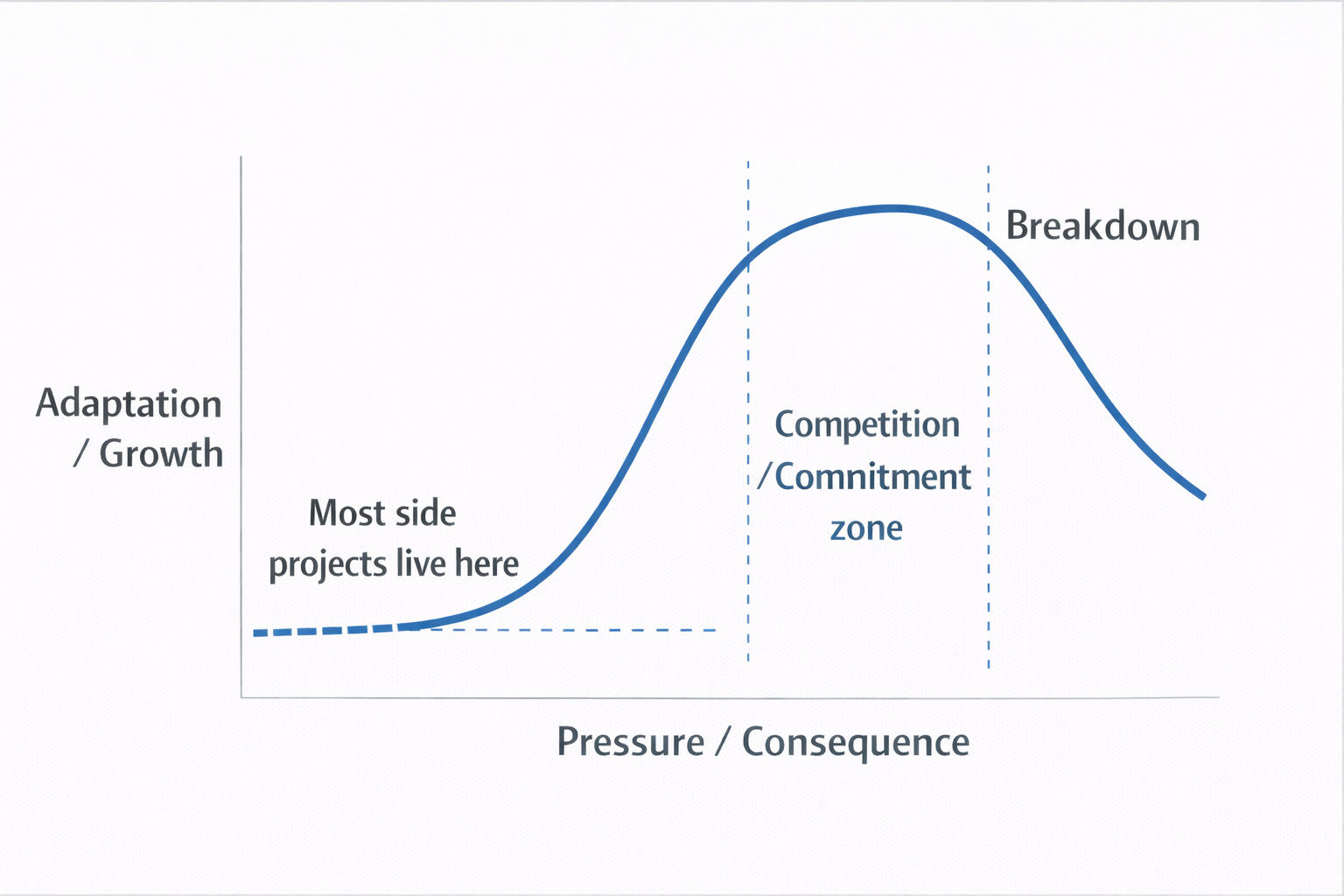
The difference is not in the activity level. It is closure.
Practice without consequence loops endlessly. Competition forces completion, feedback, and identity reinforcement.
Practice Without Stakes Trains the Wrong Reflexes
Every training environment trains reflexes.
In competitive sports, athletes learn to respond to pressure, manage fatigue, and perform under constraint because competition forces those adaptations. The body and mind change in response to stakes.
Side projects train different reflexes.
A familiar pattern illustrates this. A developer plans to ship a feature by the weekend. Sunday arrives. The work feels unfinished. Shipping is postponed. Nothing happens.
In sports terms, this is like skipping a race because training did not feel perfect. There is no disqualification. No lost ranking. No visible downside.
The nervous system learns the same lesson in both cases. Delay is safe.
Over time, the builder stops feeling urgency, not because he lacks discipline, but because the environment has trained him not to need it.
The Slow Erosion of Self-Trust
One of the most damaging consequences of consequence-free side projects is the erosion of self-trust.
Athletes understand this intuitively. A runner who repeatedly skips races begins to doubt his own seriousness. A fighter who avoids bouts starts to question whether he can perform under pressure.
The same thing happens to builders.
Each time a builder commits to himself and quietly abandons the commitment, his internal credibility weakens. Not consciously. Behaviorally. The mind records outcomes, not intentions.
Paul Graham, programmer and co-founder of Y Combinator, has written extensively about how sustained attention signals real commitment. In training terms, athletes think obsessively about competitions they cannot avoid. Optional events never command that level of attention.
A concrete sign of erosion appears when builders stop setting firm timelines. Dates become vague. Shipping becomes theoretical. This is not patience. It is learned mistrust in one’s own commitments.
Why Motivation Fails as an Explanation
Motivation is the most common explanation offered for stalled side projects. It is also the least useful.
Athletic coaches abandoned motivation-based training decades ago. They know motivation fluctuates. Systems and consequences endure.
A runner does not show up to races because he feels motivated. He shows up because he registered, trained for a date, and knows absence carries a cost.
Builders are no different.
Naval Ravikant, investor and long-time student of human behavior and incentives, has said that self-discipline is a form of self-care. But discipline is not summoned from desire. It is shaped by consequence. Without cost, effort becomes optional, and motivation predictably collapses in the middle.
Side projects live almost entirely in that middle.
Comfort Is the Enemy of Adaptation
In sports science, comfort is a red flag. Adaptation occurs at the edge of tolerance, not within it.
Training that never produces discomfort maintains fitness but does not increase capacity.
Side projects operate inside comfort by default.
A builder refactors instead of releasing. Polishes instead of exposing. Experiments instead of committing. Each choice can be justified. None of them carries downside.
This mirrors an athlete who endlessly drills technique but avoids competition because performance would expose weaknesses. The drills feel productive. The avoidance feels rational.
What is being trained is not excellence, but delay.
Pressure Changes Cognition, Not Just Output
Pressure does more than increase effort. It changes how decisions are made.
In competition, athletes stop optimizing for elegance and start optimizing for effectiveness. They manage energy differently. They prioritize differently. They accept imperfection in exchange for performance.
Builders under consequence behave the same way.
One builder described charging even a small amount for his project as the moment it stopped being theoretical. The presence of obligation forced different decisions. The scope was cut. Features were shipped. Clarity replaced perfectionism.
Michael Jordan, widely regarded as one of the greatest competitive athletes in history, once said:
“The game has its ups and downs, but you can never lose focus on your individual goals, and you can’t let yourself be beaten because of a lack of effort.”
Competition removes the option to disengage quietly. Consequence does the same for builders.
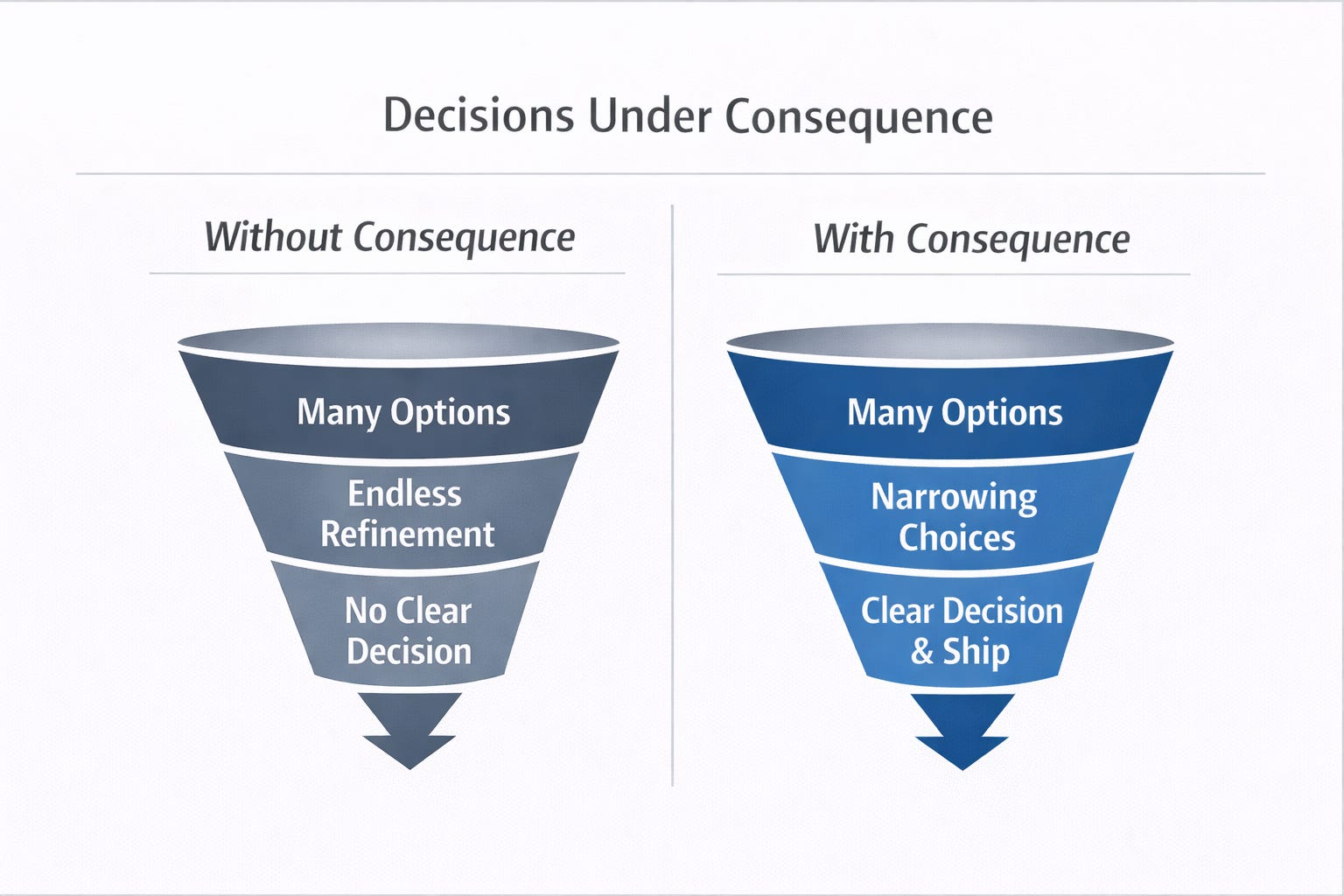
Without consequence, options stay open indefinitely.
With consequence, decisions collapse toward action.
Identity Is Forged in Competition, Not Training
Athletes do not identify as competitors because they train. They identify as competitors because they compete.
Identity forms under constraint.
The same is true for builders.
A developer who publicly commits to shipping by a date faces a choice when the deadline approaches. Cut scope or break the promise. When he ships despite imperfection, something changes internally.
James Clear, a writer who studies habit formation and identity-based behavior change, captures this mechanism precisely:
“Every action you take is a vote for the type of person you wish to become.”
Consequence ensures those votes are actually cast.
This identity shift does not come from effort alone. It comes from choosing responsibility over comfort.
Why Learning Without Stakes Plateaus
Training theory draws a sharp distinction between practice and competition. Practice builds capacity. Competition builds judgment.
Side projects are often framed as learning exercises, but learning without stakes has a ceiling.
Builders can learn tools and patterns indefinitely. They cannot learn prioritization, delivery, or decision-making under pressure without consequence.
Atul Gawande, a surgeon and researcher who studies performance under responsibility, put it succinctly:
“We learn best by being forced to take responsibility.”
Side projects that never impose responsibility trap builders in permanent practice mode.
Stress as a Signal of Meaning
Athletes do not seek stress for its own sake. They accept it because stress signals that performance matters.
Psychological research shows that stress arises when values are at risk. Responsibility creates tension. Tension sharpens focus.
Most side projects never generate this kind of stress because the outcome is optional. The builder can disengage without loss.
Over time, this trains emotional disengagement. Work that does not matter does not demand care.
Long-Term Conditioning Effects
The most dangerous consequence of consequence-free side projects is long-term conditioning.
Athletes who avoid competition become fragile. Pressure feels overwhelming, not because it is extreme, but because it is unfamiliar.
Builders conditioned in consequence-free environments show the same pattern. Deadlines feel heavy. Ownership feels risky. Commitment feels constraining.
This is not fear. It is a lack of exposure.
The muscle was never trained.
Career Consequences Mirror Athletic Ceilings
In sports, athletes who never compete rarely transition well to higher levels. Talent alone does not compensate for a lack of pressure experience.
In careers, builders face a similar ceiling.
Talented developers often stall when roles require ownership and judgment. They know the tools. They work hard. But responsibility feels heavier than expected.
Consequence-free side projects contribute to this gap. They train builders to optimize for comfort rather than accountability.
When Consequence Appears, Everything Changes
The smallest consequence can flip the entire dynamic.
One user is waiting.
One public commitment.
One obligation that cannot be ignored.
In sports, this is the difference between a training run and a race. In building, it is the difference between an idea and a responsibility.
The builder changes before the project does.
The Only Question That Matters
The most important question is not what side project to build.
It is what consequence will the builder face if he does not finish?
If the answer is nothing, the project remains practice. If the answer is something meaningful, adaptation begins.
Final Thought
Side projects do not fail because builders lack talent or ambition.
They fail for the same reason athletes plateau without competition.
Comfort preserves ability. Consequence creates capacity.
If a side project does not impose a cost on the builder, it will never demand his best.
And without demand, there is no transformation.